Thursday, 1 June 2017

Meet the Wardens

Taken under NPWS licence

It’s been a great day for the Parish here on Rockabill. First of all, we have our illustrious OverLord-and-Master Steve Newton out to visit us. He is determined to teach us his ways, and has been hand catching black guillemots all morning to assert his dominance and secure our enduring servitude.

Steve removes a GLS tracker from a Black Guillemot.


Some of the black guilles on the island had previously been fitted with GLS trackers (Geo-location systems) to give us an insight into where they spend their time during the winter.
According to the literature, Black guilles are not expected to move around much, but we will keep you posted if we find differently!


Black Guillemot with butterfish taken through a scope. 


The Return of a Hero.
Along with some much appreciated milk, Steve supplied us with  Andrew POWA! Andrew’s an old hand when it comes to terns, having been a warden on Rockabill in 2015. He’s back out to gather data on ocean contaminants for his PhD!!! Fair play Andrew. He was willing to share his tomatoes and cheese with us, so we will continue to expect great things from him: one to watch!

This week’s adventures will be the subject of blogs to follow, but since we’re finally settled and getting used to life on the island, we thought that first we should properly introduce ourselves! Without further ado, please welcome the cast of this year’s summer season: the tern wardens of Rockabill; a breed rarer than the Roseates themselves.

Shane Somers
Age: 24 and a half.
Wing span: 6’7”.
Special skill: Heavyweight Generator Starting Champion of the World (one week undefeated so far).
Shane is commander in chief out here, having spent 5 weeks on the Island last summer. He has worked with everything from sparrow weavers in South Africa to cutting edge gas sensing lasers in one of the world’s smallest labs. If his sanity survives the season, he will go on to betray his Trinity roots by undertaking a Computational Biology Masters in UCC this September.
He doesn’t have a fun fact about himself, but he’s a lovely guy, honestly.
Quote: “When Brian was here..”.
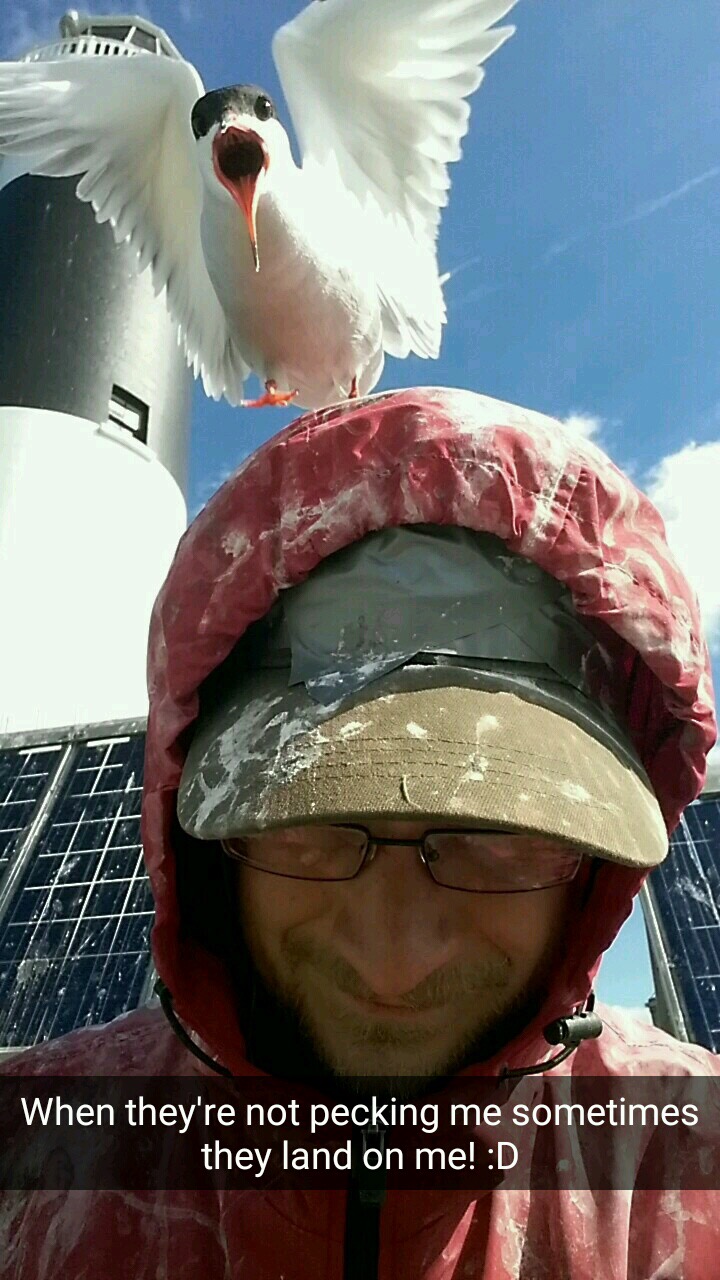


David Miley “Cyrus”
Age: Mid-forties
Ring tone: “Funky town” 
Special skill: Making delicious dinners and emitting powerful yells when they fall on the floor.
Nemesis: the Common (or garden) Tern.
On top of his secret and successful career as a teen-pop sensation, Miley is our resident handy man, responsible for building new ring reading hides and repairing lighthouse steps! Building on his origins as a Galwegian Marine Scientist, he went on to do an environmental Masters in UCD and now has an interest in everything from bat surveys to identifying grasses! He is an enthusiast of Irish biodiversity in all it’s forms, though the common terns in our densely populated Garden Five are testing his patience.
Quote: “This island has taken everything from me”.


Caroline Mckeon
Age: No longer an undergraduate
Kryptonite: Gluten
Irene  Caroline has recently finished her final exams and is eager to tell you all about it. This fast talking southside dub has exploded out of final year Trinity zoology in a blaze of glory to make her name as a Bird Saviour in the high stakes world of seabird conservation. Having recently gained the ability to differentiate between gannets and swans on the wing, this newest edition to the Rockabill crew is set to make a splash.

Quote: “Im not as posh as I sound”.


Stay tuned for updates!!! - Rockabill wardens 2017


Wednesday, 31 May 2017

Dalkey Tern Colony 2017

The first visit to the colony this season was on 10th May with approximately 50 terns on Maidens' (10 Common Tern & 40 Arctic) and 17 on Lamb. By 20th May we had all our nest boxes out, 25 on Lamb and 14 on Maidens'. We also put out lots of gravel and sand on each island to make the site as attractive as possible to breeding terns. Hopefully we can attract some Roseates, none so far! (I'm still hopeful) 

Susannah helping me put nest boxes and gravel on Maidens' Rock.

Me marking new nests on Maidens' Rock

My most recent visit to check the colony was May 30th. The colony is now up to similar numbers to last year, with 116 nests in total, with 90 on Lamb Island, 23 on Maidens’ Rock and 3 on Dalkey Island. The Dalkey Island birds are surrounded by breeding large gulls, within 3 metres of a Great Black-backed Gull nest. I don’t know why they chose that spot when there’s a much nicer and safer spot on Lamb but fingers crossed they are successful.

Nest with 3 Arctic Tern eggs, Picture taken under licence from NPWS, Susannah Cass. 


Very unusual to get 4 eggs in an Arctic Tern nest, probably one laid by another tern, picture taken under license from NPWS, Andrew Butler


Nest boxes and Arctic Terns nesting on Lamb Island, Andrew Butler


Loading Ken’s boat with new nest boxes at Coliemore Harbour, Susannah Cass


I hope to do regular visits throughout the season to track the progress of the colony and hopefully get some Roseate Terns nesting too.

Johnny the ferryman bringing me out for my regular visits. Lamb and Dalkey Islands in the background.


Events

The Dalkey Tern Watch is running every Tuesday Evening 5-8pm until the end of July at Coliemore Harbour as well as Saturday events, dates to follow.

The next events are this weekend, Sunday 4th & Monday 5th. 11am-1pm I’ll be running the Tern Watch as normal and then 2:30, 3:30 & 4:30pm I will be running 40 min guided walks on Dalkey Island. You need to make your own way to the Island (ferry), meeting at the pier on the Island. So the event is weather/boat dependant.

The first 2 Tuesdays have been very nice with lovely weather but I wouldn’t mind a few more visitors, so anybody thinking of coming along, please do.

The species list from Tuesday the 23rd of may.


All events will be advertised on:


Friday, 19 May 2017

Day 13 on The Rock!

(Article authored on Thursday the 18th of May 2017)
The bird of the season, Sterna dougallii A.K.A. The Roseate Tern, mid-preen [(Photograph courtesy of Shane Somers) Taken under NPWS License]

Day 13 in the Big Birdy House, oh sorry I mean Rockabill Island. Today is the first full day for our newest arrival Caroline McKeon, fresh in from finishing her final exams in Zoology, congratulations and fair play Caroline! We’ve been showing her the ropes and getting her used to all her new wardening duties. It’s also a day mixed with a tinge of sadness at losing our former Rockabill Warden/Blog writer/Pun Enthusiast Irene Sullivan yesterday, who has moved into a luxurious caravan in Kilcoole where she will be working as a Little Tern Warden and has access to all the pleasantries of mainland life such as running water and showers within a ten minute walk from her residence. 

A brand-spanking-new batch of nest-boxes thanks to the crafty students of Balbriggan Community College! Thanks folks! (Photograph courtesy of Shane Somers)

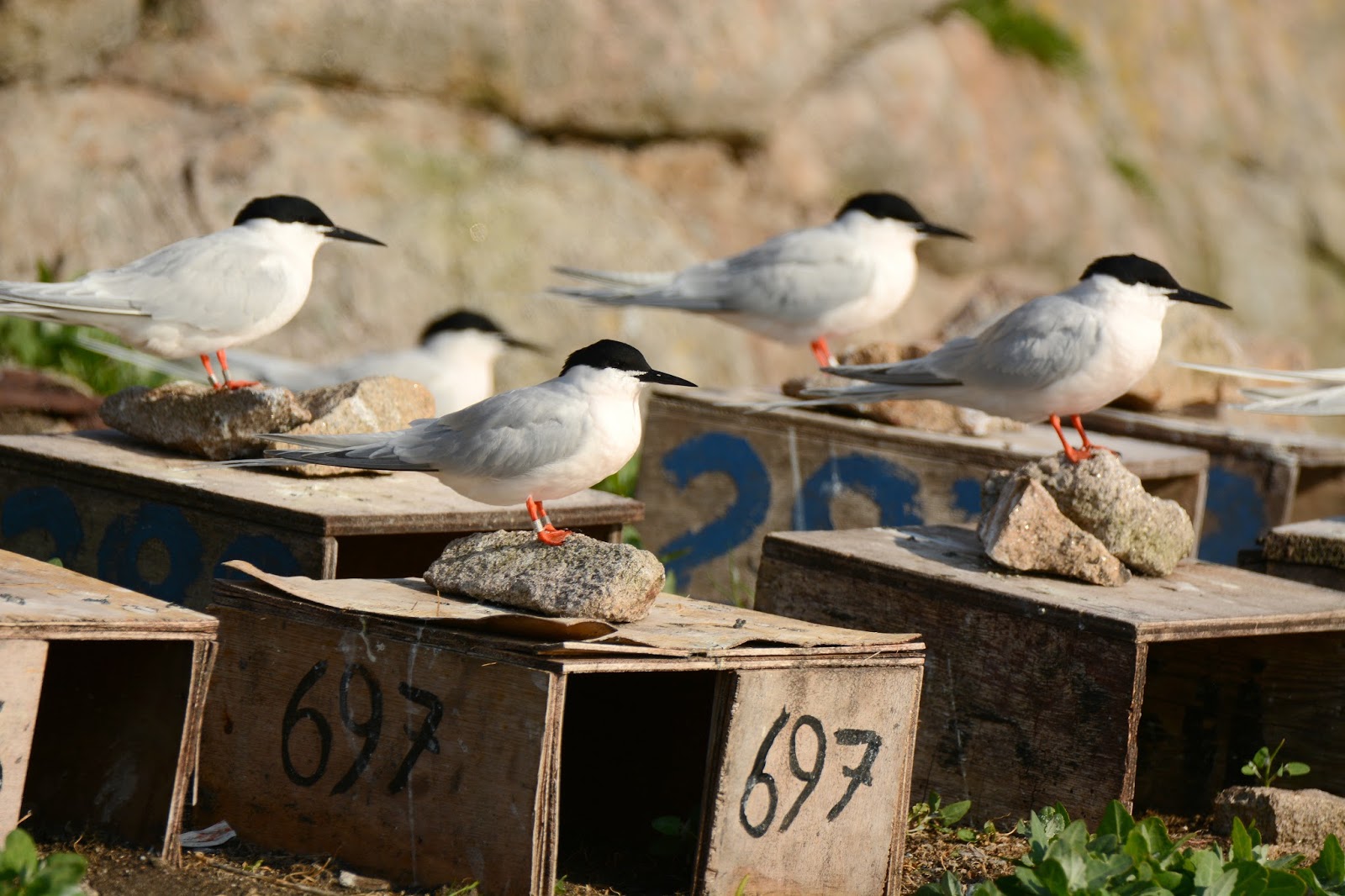
Along with our warden exchange we also received a fresh shipment of finely crafted and greatly appreciated nest boxes from the kind and skilled students of Balbriggan Community College. No time has been wasted in getting these precious love shacks out to the various sites around the Rock where they will provide ample protection for nesting Roseate Terns, their clutches of eggs and soon to be pulli (that’s chicks that haven’t fledge yet, for the uninitiated). Nest boxes have been instrumental in increasing the Roseate Tern population on Rockabill, they protect eggs and chicks from what can be extremely harsh weather conditions on this tiny island, as well as providing a hideout from the prying eyes of a variety of predators. So thank you very much to all the students and staff at Balbriggan Community College your work and generous donations will contribute to the conservation of one Europe’s rarest breeding seabirds! 


The old and the new; a row of our old and deteriorating boxes against our shiny, generously contributed, new boxes! [(Photograph courtesy of Shane Somers) Taken under NPWS License]

It doesn’t take long after deployment for our Rosies to start scouting out new boxes, as the pairs have a squawk about the new real estate, a bit of a perch and see if this is the next rung on the property ladder for them. Once the decision is made they’ll settle and get a scrape going, forming a nice fresh bowl under their luxurious ceilings and, with any luck, eggs.


Things are changing rapidly around Rockabill, we had our first Roseate egg on the 13th after a quiet lull of no other eggs in sight for 4 days, it’s all starting to happen at once with eggs springing up all over the place since yesterday (May 17th), it’s keeping myself, Shane and Caroline on our toes (literally: we have to be very careful moving around the island as eggs can be laid and hidden anywhere!).

Well that’s all for now everyone thanks for reading and may your day be filled with a lot less bird guano than mine! :D

Yours Truly
David Miley

Tuesday, 16 May 2017

Rockabill Island Blog- The Season Commences

The year 1989 marks two very special occasions; the birth of one of this year’s Rockabill Wardens, David Miley, and the year Birdwatch Ireland began monitoring and protecting the Roseate Tern breeding colony on Rockabill Island, situated off the coast of Skerries, Co. Dublin. For those of you finding these blog posts for the first time, the Rock component of the island supports a lighthouse and accompanying accommodation. It is a stunningly beautiful location, providing highly significant breeding grounds for many species of seabird. These include Black Guillemots, Kittiwakes, Common Terns, Arctic Terns, and the species of primary concern for resident wardens, the Roseate Tern- the conservation of which by Birdwatch Ireland staff would not be possible without the efforts and contributions of the National Parks and Wildlife Service, and the EU LIFE Nature Project.
 
Rockabill Island lighthouse.

Kittiwakes perched on their most densely populated nesting area, known as “Kitti-City.”(picture taken under NPWS license)
Roseate Tern. (picture taken under NPWS license)
2017 marks the 29th year of wardening on Rockabill (woo!) and also marks the first year in which three wardens have been committed to the project for the full season. This year’s devoted tern protectors are Shane Somers, David Miley, and Caroline McKeon, with Irene Sullivan filling in before Caroline’s arrival on the 17th of May. Shane spent 6 weeks on Rockabill last summer, and as such spent some time showing his colleagues the ropes...

Tool safety training.


This year, the wardens arrived on the island on the 6th of May by ferry. Eoin and his boat, “Fionn Mac Cumhaill,” kindly brought the three wardens and their supplies of food and gear to the island. The wardens were also accompanied by a team of Skerries Sea Scouts, who volunteered to assist with the vital vegetation clearing that allows terns to nest unimpeded on Rockabill. The scouts brought energy, dedication and Coco-Pop Rocks, and their contribution was massive- so thank you lads!!
 
Common Terns in flight. (picture taken under NPWS license)
The first few days of the project involved clearing massive amounts of mallow and scurvy grass, readying study sites for nest boxes, and erecting hides. We were treated to spectacular weather and the sun split the stones of Rockabill while we prepared the island for nesting terns.

Shane and project leader Dr. Stephen Newton assembling a new hide.

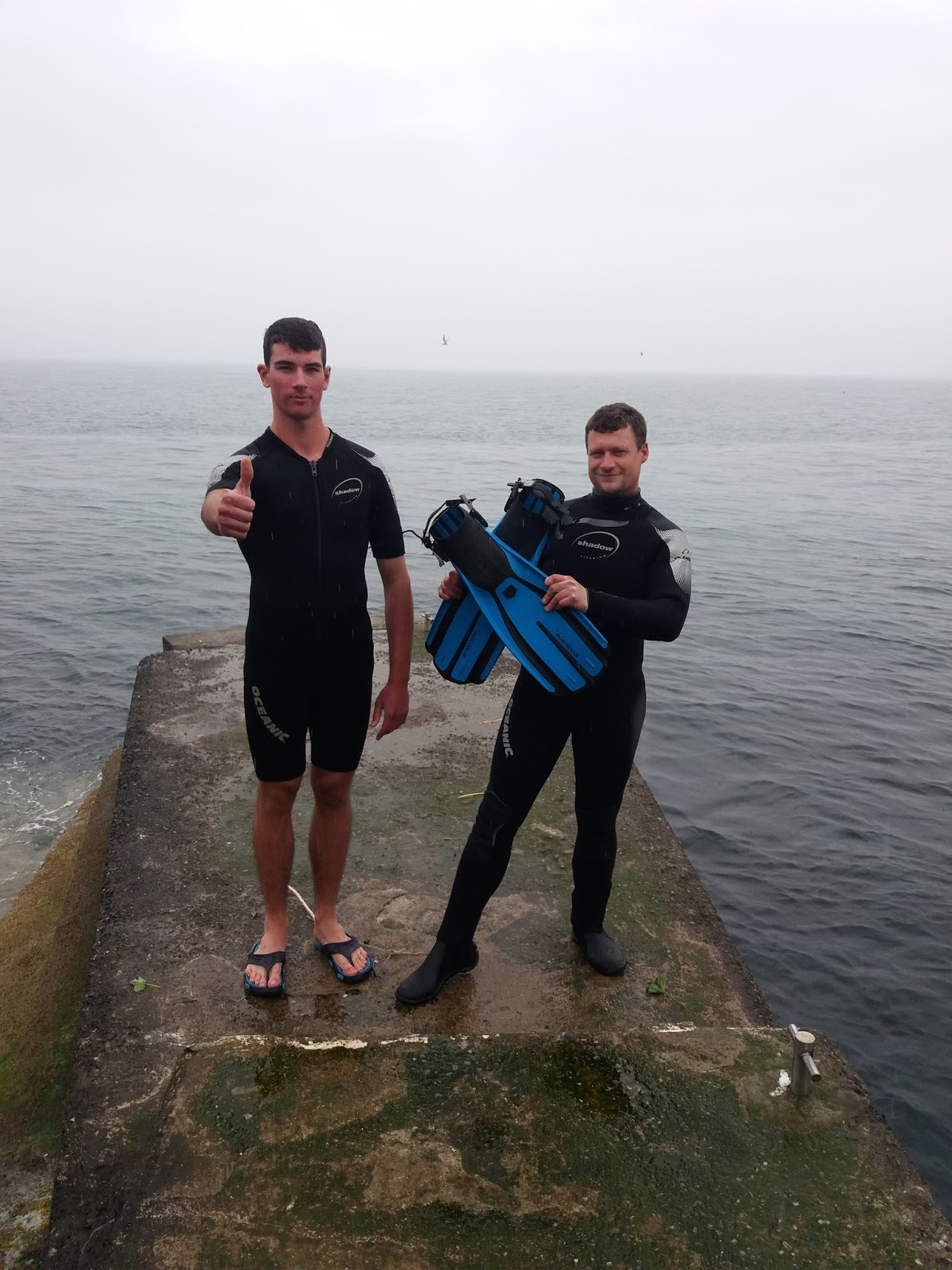
Numerous bird species can be spotted on Rockabill; a broad diversity of which have already been encountered this year. These include puffins on the surface of the sea, cormorants and shags, turnstones, oyster-catchers, and non-seabirds such as swallows and warblers. The Bill component of the island can be accessed by boat or, if you’re feeling frisky, by swimming. David and Shane both braved the elements in their efforts to intimidate potential tern predators on the Bill.
 
Shane's and Miley's gear was wet-suited - I mean, well-suited to the conditions.
This year's first Roseate Tern egg was discovered by Irene on the 13th of May. Though an egg laid this unusually early in the season is likely to be an outlier, it is exciting to see the progression of the season as the terns settle on nest boxes and begin to scrape bowls on Rockabill.

As part of the introduction of this year’s wardens, it seems fitting to have their portraits included. Here is Shane in his natural state:

And here is David, in his characteristic robe after a hard day’s work at the office.


Stay tuned for updates on the progression of this year’s occupation of Rockabill!


- Irene Sullivan


Thursday, 29 September 2016

Rocky year for Roseates on Rockabill

Apologies for the major radio silence - the end of the season is one of our busiest times on Rockabill (along with the start of the season, and the middle of the season...) and after that followed our reintegration back into normal society, followed by a couple of weeks of data analysis and report writing! With all of that behind us we're now in a position to tell the story of how the biggest colony of Roseate Terns in Europe got on this year.

Roseate Terns on Rockabill, Summer 2016. (picture taken under NPWS license)

Large seabird colonies are all about life and death - Adults have to survive the winter and many undertake epic challenging migrations in the hope of reaching the colony, finding a mate and raising chicks. Many mate and produce eggs, which don't make it to hatching because of predation or harsh weather. Others manage to incubate and protect their eggs long enough for them to hatch, only for the chicks to die somewhere in the month or so it takes for them to grow feathers and begin to fly, again with predation and harsh weather the typical causes. Perhaps most heart-breaking of all is when adults pass all those hurdles of protecting their eggs and raising the chicks until they can fly, only for those fledglings to be predated soon after.

Roseate Terns early in the 2016 breeding season on Rockabill  (picture taken under NPWS license)

Roseate Terns on their nestboxes early in the 2016 breeding season  Rockabill. (picture taken under NPWS license)

We take it for granted that birds and mammals raise chicks and cubs every year, but sometimes we forget the gauntlet of challenges and hurdles they have to overcome to do that. Some, like many garden birds, have evolved to live short lives and aim to produce big numbers of offspring every year by laying lots of eggs and having more than one brood per summer. Others, like most seabirds, live long lives and put their time and energy into raising one or two chicks per year. Both strategies mean that their populations should be able to persist through a bad year or two, hopefully compensating with a good year or two or at least plenty of 'average' years. With that in mind, was this a good or a bad year for our Roseate Terns?


The Good:
Regular followers of the blog will remember the very pleasant surprise we had in late-June that the number of breeding pairs of Roseate Terns on Rockabill had risen by around 200 pairs to over 1,550. Given that Rockabill holds the biggest numbers in Europe this was a very welcome boost, and together with the work we're doing as part of the EU LIFE funded project with our partners in the RSPB and the North Wales Wildlife Trust it should help us secure they're future in this part of the world over the coming years.

In addition to that, the number of eggs laid by each pair was normal (I mean that in a good way!) and hatching rates were high too. We put out around 750 nestboxes and over 90% were occupied, the highest occupancy we've recorded to date! So there was plenty of good news by the middle of the season.

Roseate Tern sitting on its two eggs on Rockabill, Summer 2016. (picture taken under NPWS license)

Our new ring-reading hide, terracing and nestboxes, Summer 2016. (picture taken under NPWS license)

The first Roseate Tern egg on Rockabill in 2016 (picture taken under NPWS license)


The Bad:
It was around late June when our first Roseate chicks began to hatch, and unfortunately that's where the good news for this season ended. It very quickly became apparent that chick survival was going to be low. In almost all nests with two chicks the younger sibling died within 4 or 5 days. We weigh and measure chicks on a daily basis and this confirmed that growth rates were well below what they should be. During our chick-feeding studies we usually see the older chick getting two thirds of the food, with the younger chick managing to get some when the big chick is full. This year the older chick was never full however and kept competing for any incoming food, at the expense of the smaller chick. Our final tallies revealed that Roseate Tern productivity, i.e. the average number of chicks fledged per pair, was the lowest we've seen it on Rockabill with only 6 or 7 chicks surviving out of every 10 nests. Last year we ringed around 1500 Roseate Tern chicks whereas this year we ringed around two-thirds of that, despite having more pairs breeding this year.

A 'blonde' Roseate Tern chick on Rockabill, Summer 2016. (picture and handling under NPWS license)
Roseate Tern fledgling and parent on Rockabill, Summer 2016. (picture taken under NPWS license)


The Future:
I started this blog during the 2014 season and anyone following it since then might think this all sounds very familiar. The results of the 2014 season were very similar to 2016. Thankfully last year everything went well and breeding numbers and chick survival were all high. Those good years balance out the bad years, and it's because we've had a lot more good years than bad years that the Rockabill population of Roseate Terns has continued to grow since we started this conservation project in 1989. The frequency of bad years due to lack of suitable fish prey (2 of the last 3) is certainly cause for concern. It doesn't mean next year won't be fine, but how long until we have another bad year again? Were these temporary anomalies in suitable fish-prey numbers in the Irish Sea or are we seeing the start of a larger problem? Only time will tell.

Roseate Terns gathering on the edge of the colony at the end of the season (picture taken under NPWS license)

Earlier in the season we knew that Little Terns didn't even attempt to breed at their usual colony at Baltray in Louth, further north in the Irish Sea, and local fishermen commented on the lack of Sandeels in the area. Tern colonies at Dublin Port, Dalkey and Kilcoole all had a poor year too. Issues of predation played a larger part there, but there may have also been a lack of food. Thankfully our colleagues at Tern colonies further afield in the Irish Sea reported good years overall. Long-term and widespread monitoring  helps us see the bigger picture not only about our seabird populations, but the ecosystems and species they rely on and exist with. With that in mind we learned a lot in 2016. It'll be interesting to see what 2017 brings!